
'Trump's desecration of all that Obama represented can be seen at different levels: Personal, political, systemic and structural,' explains Ambassador B S Prakash.
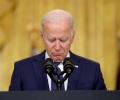
Afghanistan will remain a frontline state for Washington for a foreseeable future in terms of the potential threats to US national security from terrorist groups, asserts Ambassador M K Bhadrakumar, who played a stellar role in beginning India's dealings in Afghanistan in 1994.
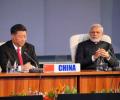
'Modi's finest political legacy ought to be a border settlement with Beijing,' asserts Ambassador M K Bhadrakumar.
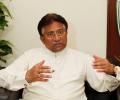
Learning perhaps from the Kargil debacle, Musharraf tried hard to evolve as a statesman in his dealings with India, recalls Rana Banerji, who headed the Pakistan desk at RA&W.

The excise duty collection grew by 81 per cent in first quarter against the budgeted 21.7 per cent.

Nifty, which has struggled around 8550-8560 levels managed to blast past this resistance and close above the psychological mark of 8600.
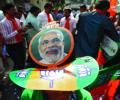
Retired senior US diplomats Teresita and Howard Schaffer believe the 'US cannot afford to continue restricting its contacts with Narendra Modi.' Rediff.com's Aziz Haniffa reports from Washington, DC.

by External Affairs Minister Natwar Singh, Chinese Foreign Minister Li Zhaoxing and Russian Foreign Minister Sergei Lvavrov met at the Chinese mission in New York.

'As far as acquisition of Russian equipment is concerned, with about 70% of Indian military equipment being of Russian origin, a sudden decision to abandon imports from Russia is not feasible,' points out Brigadier S K Chatterji (retd).

But why should India be talking to the Taliban in the first place? There is no love lost there. India will never forget or forgive the humiliation to which the Taliban subjected it in the IC-814 hijack, notes Shekhar Gupta.
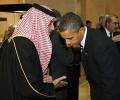
Further deterioration of the US-Saudi relationship will have geo-economic and geopolitical effects, says Nitin Pai.

'The US appears to think that Pakistan is highly vulnerable today due to its economic crisis and one more turn of the screw may bring about desired results,' says Ambassador M K Bhadrakumar.

India cannot choose its geography and devise regional strategies to dovetail into the Western Indian Ocean hypothesis conceived in the Pentagon, argues Ambassador M K Bhadrakumar.
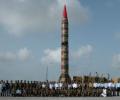
Saudi Arabia has invested in Pakistani nuclear weapons projects and believes it could acquire atomic bombs "at will", the BBC reported on Thursday.

World leaders are reacting with caution to Donald Trump's jaw-dropping victory in the US presidential election, with some of them reminding him of the democratic values and the global responsibility he carries.
United States president-elect Donald Trump's tweet for strengthening and expansion of country's nuclear arsenal is indicating a major policy change as against the Obama Administration which had pushed for reduction and ultimately elimination of nuclear weapons.

'A bit of marketing, a bit of positioning, and a lot of strategic thinking is required, and all this should be in aid of India's strategic intent: Becoming the third pole in a global G3 and aiming for Numero Uno,' says Rajeev Srinivasan.

"No leader or policymaker involved will claim to have gotten everything right in the region, Iraq especially," he said.

'As in the Panchatantra tale of the cat and the monkeys, it is possible for the clever swing State to play off the two competing powers.'

'The optimistic advice might be "fasten your seat belts" and the pessimistic one might just turn out to be "brace for impact",' says Claude Smadja.
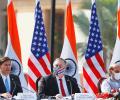
China is now the most significant strategic concern in Washington, as in most of the world's capitals, especially the democracies. Today, strategic autonomy has acquired a sharper definition: To ward off the Chinese challenge to India's territorial integrity, sovereignty and regional stature, observes Shekhar Gupta.

President Obama had no intention of risking a global conflagration on account of the use of chemical weapons in Syria, especially at a time when he was struggling to wind up the wars his predecessor had started, says T P Sreenivasan

In perhaps the first major conference on the United States-India strategic partnership in the aftermath of the Khobragade controversy that plunged the bilateral relationship in a downward spiral and is now in the process of being resurrected, the undeniable consensus among the panelists and participants was that much ballyhooed strategic convergence between Washington and New Delhi has dissipated.

With Iran reaching an agreement on its nuclear programme, India is expected to be one of the major gainers.

Russia and China have a broad consensus today on almost all core issues related to global strategic stability, which is unprecedented in modern history, observes Ambassador M K Bhadrakumar.
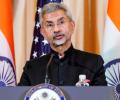
'What Jaishankar says is simplistic.' 'The past does not matter that much.' 'If we think that it does it is because we are not good enough at running the nation competently today and are searching for excuses why,' argues Aakar Patel.

Ahead of Russian President Vladimir Putin's India visit, the United States has said it would not impact President Barack Obama's trip to the country in January but warned now was not the right time to do business with Russia.
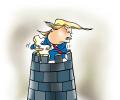
Like Mr Trump, says Kanika Datta, politics tempts many businessmen.

'Just how strong were the ties between the world's largest and oldest democracies that an incident involving a diplomat and a maid led to anger threatening the relationship itself? Or had the relationship been weakening in the past few years, masked by the empty symbolism of State dinners, asks Devesh Kapur.

The rupee appreciated by 37 paise to 62.12 against the dollar in early trade on Monday.

Internal strife and tribalism is endemic to Afghanistan, notes Colonel Anil A Athale (retd).
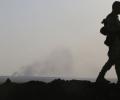
The Islamic State of Iraq and the Levant is a dangerous phenomenon, but the terrorist organisation can not be defeated by air strikes alone, Iranian Foreign Minister Mohammad Javad Zarif has said.


The SCO is increasingly seen as a counterweight to NATO and its membership will help India have a greater say in issues relating to security and defence besides combating terrorism.

India, along with Pakistan, is set to be inducted as full members into the bloc, which mainly deals with issues relating to security and defence.
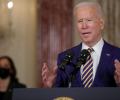
In his maiden address to the employees of the State Department, the US president said he has come to the building to send a clear message to the world: America is back. America is back. Diplomacy is back.

Ahead of the G-20 summit in Osaka this week, Xi has reasserted China's role as a global player, points out Dr Rajaram Panda.

Dealers expect prices to fall further, owing to an impending rate hike in the US
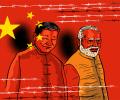
'Given the sharp increase in oil prices, a mounting problem for the 2nd and 4th largest importers like China and India -- the Qingdao meeting is likely to push for the large energy producers (Russia and the Central Asian Republics) and energy consumers (China and India) to arrive at some understanding for mutually beneficial outcomes,' notes Srikanth Kondapalli.

The terrible beauty of Doval's initiative is that it is all about a new journey rather than about a set compass pointing toward a pre-determined destination, observes Ambassador M K Bhadrakumar.
